Health & Beauty Planogram Guide & Example
A health and beauty planogram is the plan for a personal care section: which shelf or hook each product goes on, how many facings it gets, and how the set is grouped. Follow along on the 8-foot sun and skin care example as we go through how beauty brands plan one.
Used by Sun Bum, Kopari, Beauty Industry Group and more
Pitching a health and beauty planogram to a retailer
Drugstore and mass buyers reset health and beauty (HBA) sets on a seasonal calendar, and they expect a brand to show how its line fits their shelf in each season.
What a supplier's planogram looks like
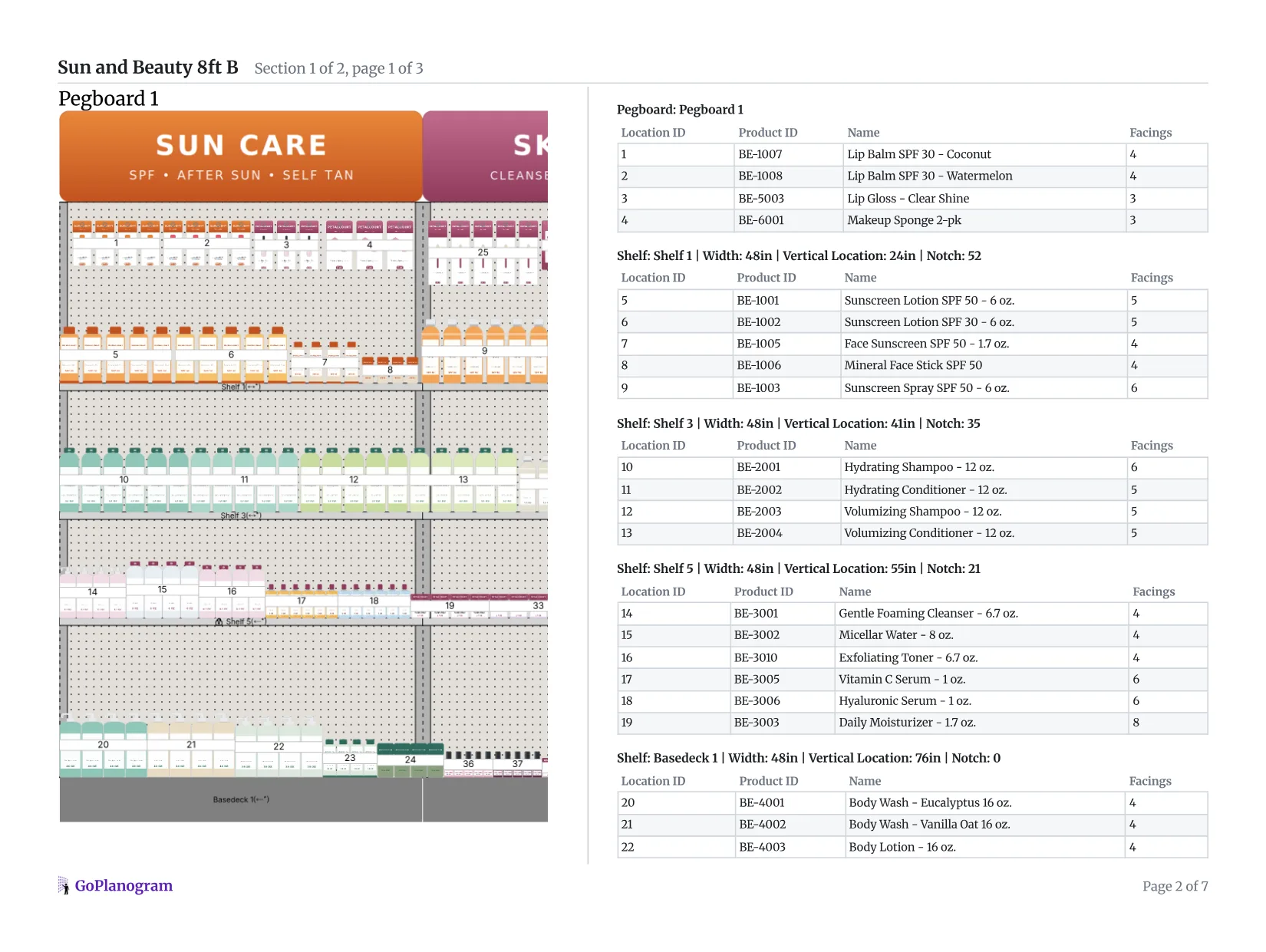
This is the side-by-side report GoPlanogram makes from a planogram: the section on one side, the list of what goes where on the other, with a bill of materials for the fixtures at the end.
- 1
Front and 3/4 views
The report opens with the set drawn flat and in 3D, so the buyer sees how it will look in the store before anything is reset.
- 2
Location IDs
Bottles, tubes and hook items are numbered to their rows in the list, so the regimen order and every small item end up where you put them.
- 3
Facings per SKU
Facings per product show the buyer how the set changes between the in-season and off-season versions of sun care.
- 4
The numbers for every bay
Each bay's weekly sales, sales per square foot and margin, then a chart of sun, skin, hair and body care by share of space and sales, for when you're arguing for eye-level space for premium items.
For the line review itself, GoPlanogram also compares planograms, so the buyer sees what changed from last year's set.
Personal care brands that plan in GoPlanogram



What buyers expect
In-season and off-season versions
Sun care and other seasonal categories grow and shrink through the year, so buyers expect a plan for both sizes of the set.
Grouping by need and regimen
Products organized the way shoppers build a routine, with your items placed inside the retailer's flow rather than apart from it.
A plan for small items
Lip, nail and accessories on hooks or in trays so they stay faced, and a thought for where higher-theft items should go.
A schematic, SKU list and PSA
Drugstore buyers review a picture and an item list. Chains on JDA / Blue Yonder Space Planning want the PSA file too.
How should a health and beauty section be set?
Beauty sections hold many small, similar products that shoppers compare closely, so the set has to be easy to browse and easy for staff to keep tidy.
Follow the regimen
Lay skin care out in the order it is used: cleanse, tone, treat, moisturize. Shoppers building a routine can move along the shelf one step at a time, and add the step they are missing.
Flex sun care for the season
Sun care peaks in spring and summer and shrinks in the fall. Plan an in-season and an off-season version of the section, so the space goes to whatever is selling.
Sort by type, then strength
Within sun care, group lotions, sprays, face and lip, then order each by SPF. The same idea works for hair care by hair need and for skin care by concern.
Let color flow
Arrange nail and lip color in a deliberate shade order, light to dark, so shoppers can compare shades side by side.
Hook and tray small items
Lip balm, nail polish, sponges and hair accessories are easy to lose on an open shelf. Peg hooks and trays keep them faced and countable, and higher-theft items can go where staff can see them.
Premium at eye level
Serums, treatments and other higher-margin items earn the eye-level shelves. Larger, value-sized bottles of body wash and shampoo work lower down.
What order should skin care go in?
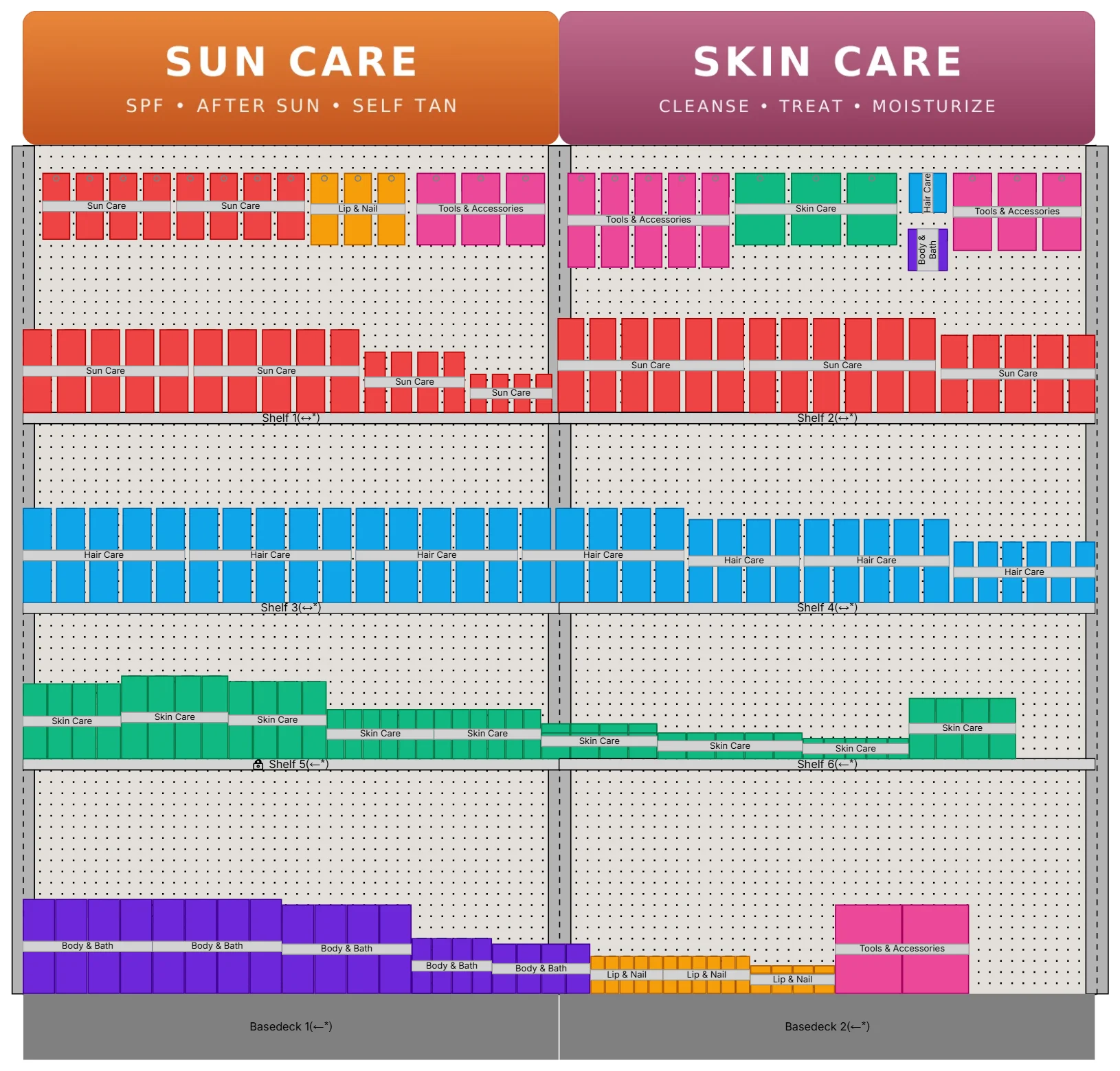
Skin care set by regimen, in the order shoppers use it, running in the direction of traffic.
| Step | Products | Placement |
|---|---|---|
| Cleanse | Cleansers and micellar water | Start of the run |
| Tone | Toners | Next to the cleansers |
| Treat | Serums, eye cream and masks | Eye level, as the higher-margin step |
| Moisturize | Day and night moisturizers | After the treatments |
| Protect | Face sunscreen | End of the run, beside sun care |
How to make a health and beauty planogram in 5 steps
- 1
Ask how the buyer sets the aisle
Drugstores tend to group by need or regimen, and some mass chains by brand. Ask which, and when seasonal sets like sun care swap in and out.
- 2
Fit the space and fixtures you have
The buyer sets your feet, shelves and any pegboard or trays, usually from the current set. Put small items like lip and nail on the hooks or trays you have.
In GoPlanogram: Bins and trays can be drawn to the store's sizes, so lip and nail items sit in the same cells they will in the store. How it works
- 3
Group by need and regimen
Run skin care in the order it is used, sun care by type then SPF, and let lip and nail color flow light to dark.
- 4
Set facings and eye level
Give best sellers more facings, put serums and treatments at eye level, and move value-sized bottles lower.
In GoPlanogram: A sales or margin heatmap shows at a glance whether your premium items are really at eye level. How it works
- 5
Plan both seasons and deliver
Build an in-season and an off-season version, and send the buyer both, each with its schematic and SKU list.
In GoPlanogram: A comparison of the two versions marks every item added, moved or dropped between seasons. How it works
You can try steps 2 to 4 on the example below. Add shelves builds the fixture, and the demo catalog has the products.
How do drugstore, mass and beauty store planograms differ?
The same brand can get two shelves in a drugstore and a whole wall in a beauty store.
Drugstores
CVS, Walgreens, Duane Reade
Many short categories in a small box, with health and beauty side by side. A drugstore planogram for sun care swaps in and out on a set schedule.
Mass and grocery
Walmart, Target, Kroger
Long health and beauty aisles with national brands and store brands together, plus seasonal endcaps that carry much of the sun care volume.
Beauty specialty
Ulta Beauty, Sally Beauty, Sephora
Brand-blocked walls, more brands per category and room for testers, with a stronger focus on presentation and discovery.
Retailer names are trademarks of their respective owners and are used only to describe the stores these planograms suit. GoPlanogram is not affiliated with or endorsed by them, and these examples are not any retailer's official planograms.
Try it in GoPlanogram
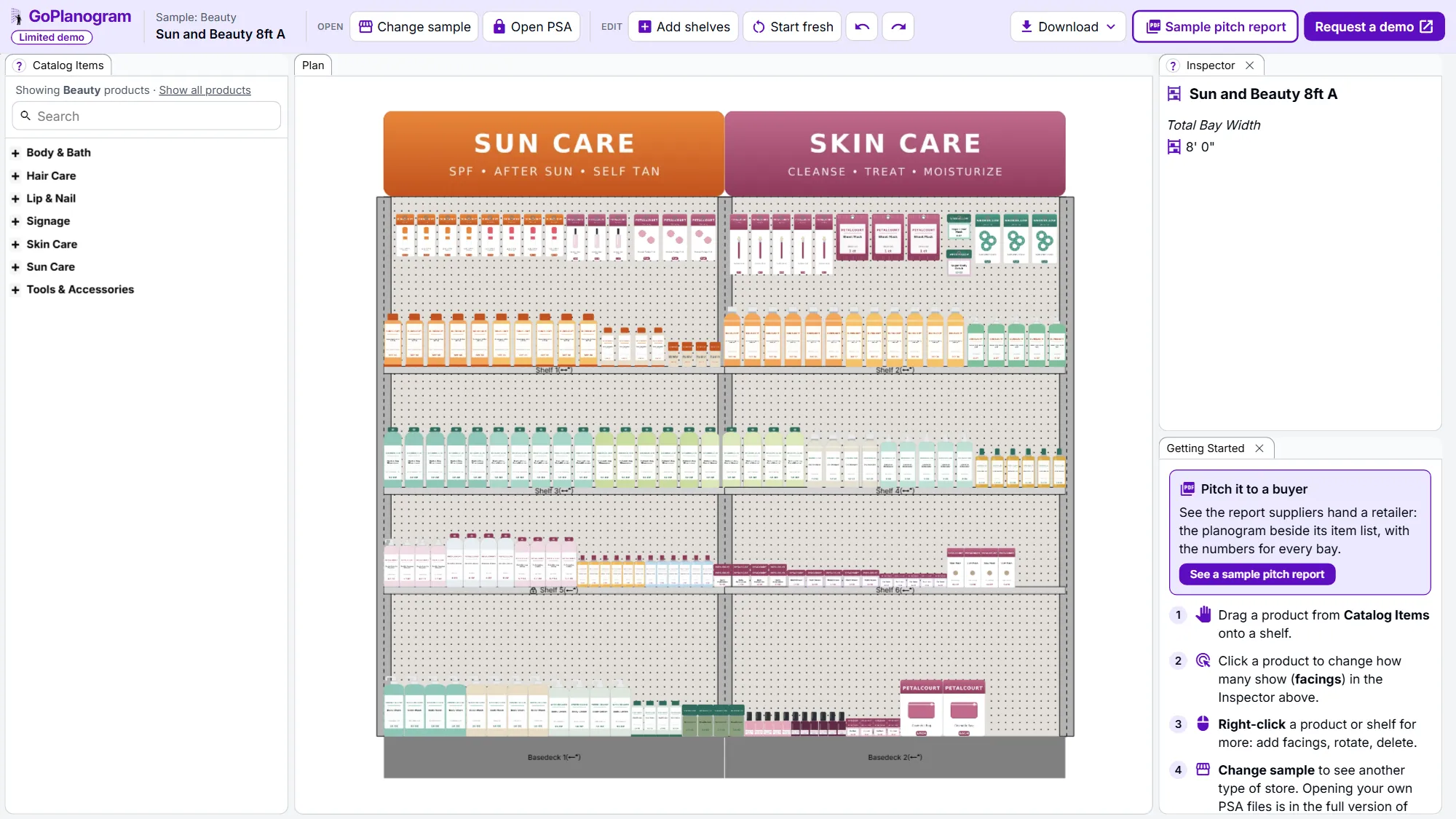
Open the example in a limited demo of GoPlanogram: move products, change facings, add shelves and download an image. Your own catalog, saving, PSA files, reports and analytics are in the full version.
A limited demo of GoPlanogram, with fictional demo products. No signup needed. Works best on a computer or tablet.
What's in the health and beauty planogram example
The example is an 8-foot section under sun care and skin care headers. Its shelves hold sunscreen lotions and sprays, face sunscreen, a mineral face stick and after-sun aloe; shampoo, conditioner, styling and hair treatments; and cleansers, micellar water, toner, serums, moisturizers, eye cream and a clay mask.
Small items hang on pegboard: SPF lip balm, lip gloss, sheet masks, makeup sponges and scrunchies. Body wash, lotion, nail polish and other body care sit on the base decks, for 41 fictional demo SKUs grouped by need. Try moving the serums down a shelf, or shrinking sun care to its off-season size.
Beauty categories in the demo catalog
- check Sun care: body, face, lip and after-sun
- check Skin care: cleansers, toners, serums, moisturizers and masks
- check Hair care: shampoo, conditioner, styling and treatments
- check Body and bath: body wash, lotion, scrubs and deodorant
- check Lip and nail
- check Beauty tools and accessories
What this demo leaves out
The demo is GoPlanogram with most of it switched off. The full version is what suppliers and retailers plan with every week, with their own catalog, data and team.
It starts at $5,500 a year for five users, with unlimited planograms and support included. See pricing
| Feature | This demo | Full GoPlanogram |
|---|---|---|
| Drag-and-drop products onto shelves and pegboard | check Included | check Included |
| Example planograms with demo products | check Included | check Included |
| Download as an image | check Included | check Included |
| Import and export JDA / Blue Yonder PSA files | Not included | check Included |
| Your own product catalog, images and dimensions | Not included | check Included |
| Save, version and share planograms with your team | Not included | check Included |
| Every fixture type, fully configurable | Not included | check Included |
| Sales and margin heatmaps, space-to-sales reports | Not included | check Included |
| Pitch-ready PDF reports for buyers, plus spreadsheets and CSV | Not included | check Included |
| Compare a proposal with last year's planogram | Not included | check Included |
| Reusable components, templates and assortments | Not included | check Included |
Health and beauty planogram FAQs
- What is a health and beauty planogram?
- It places each personal care product on a shelf or hook and sets its facings. Beauty planograms are usually grouped by need and regimen, with small items on hooks and seasonal categories like sun care planned in two sizes.
- What should a beauty brand include in a planogram proposal?
- Where your line sits in the retailer's grouping, the facings you recommend backed by sales, in-season and off-season versions for seasonal categories, and a schematic, SKU list and PSA file the buyer can work from.
- Can I make a CVS, Walgreens or Ulta planogram?
- Yes, as a proposal for your line. Drugstores fit many short categories into a small box and swap seasonal sets on a schedule, while Ulta brand-blocks whole walls. Either way, GoPlanogram can draw the set on the store's own shelves, pegboard and trays.
- How should sun care be organized?
- Group by type first (body lotions, sprays, face and lip), then order each group by SPF. Keep after-sun next to it, and plan a larger in-season version of the section and a smaller off-season one.
- Does it include cosmetics?
- Enough for a simple cosmetics planogram: the demo catalog has lip and nail color and beauty tools such as brushes and sponges, along with skin, hair, sun and bath care. Choose Show all products in Catalog Items to see everything.
Plan beauty sets for every retailer you sell to
Beauty brands plan their in-season and off-season sets in GoPlanogram from their own catalog and sales, and send buyers a side-by-side PDF, a spreadsheet or a PSA file.
Request a demo
A live walkthrough with the team that makes GoPlanogram.
See everything in the full version
Read the full feature list and our published pricing, no form required.

