Clothing Store Planogram Guide & Example
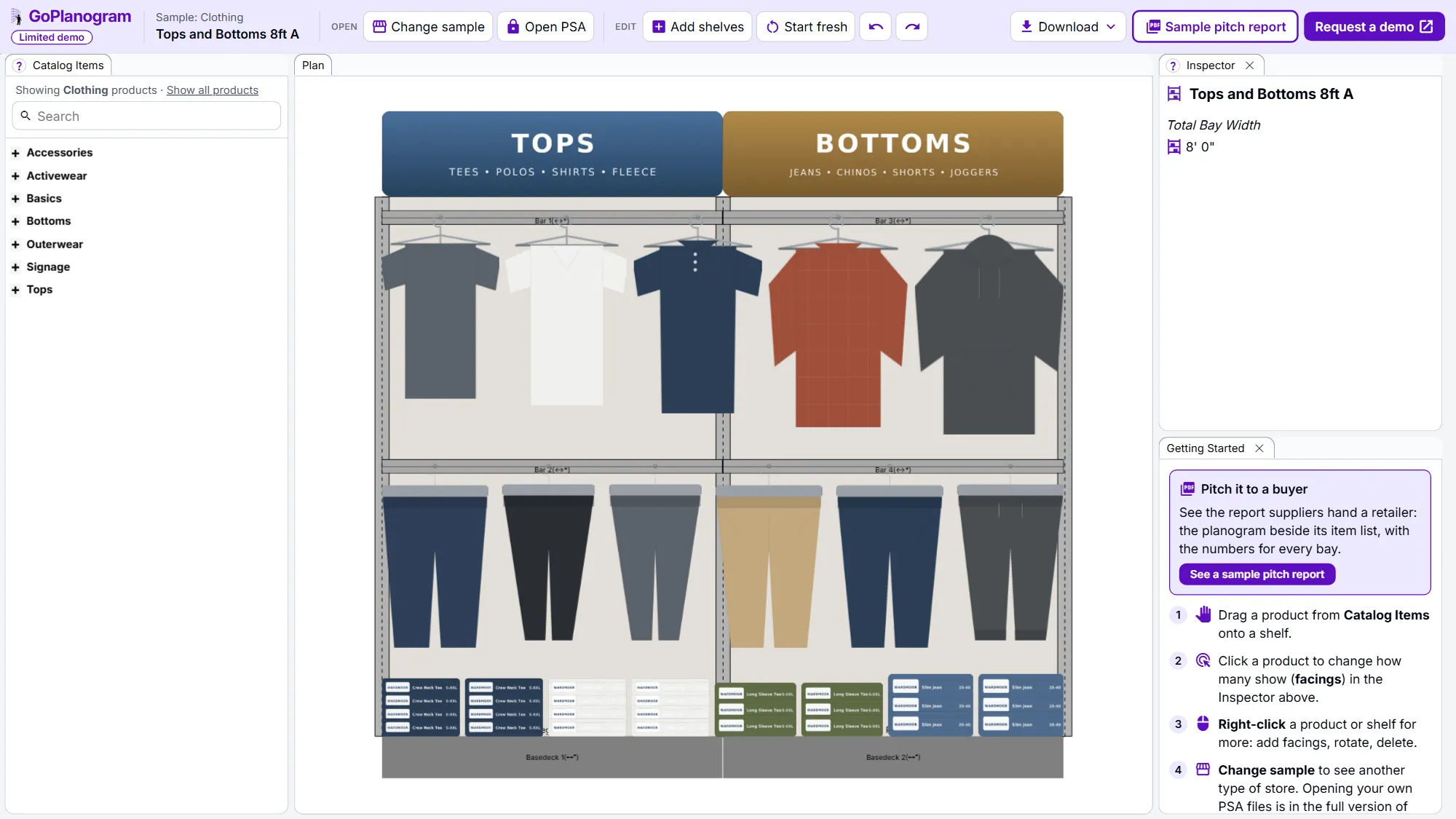
A clothing store planogram is the plan for an apparel wall or fixture: which bar, shelf or hook each style goes on, and in what order. This page covers how apparel brands plan one, and the 8-foot tops and bottoms wall below is there to open and edit.
Pitching an apparel planogram to a retailer
Mass and department stores send one wall plan to every store, so an apparel brand’s planogram has to hold up across sizes, colors and store formats.
What a supplier's planogram looks like
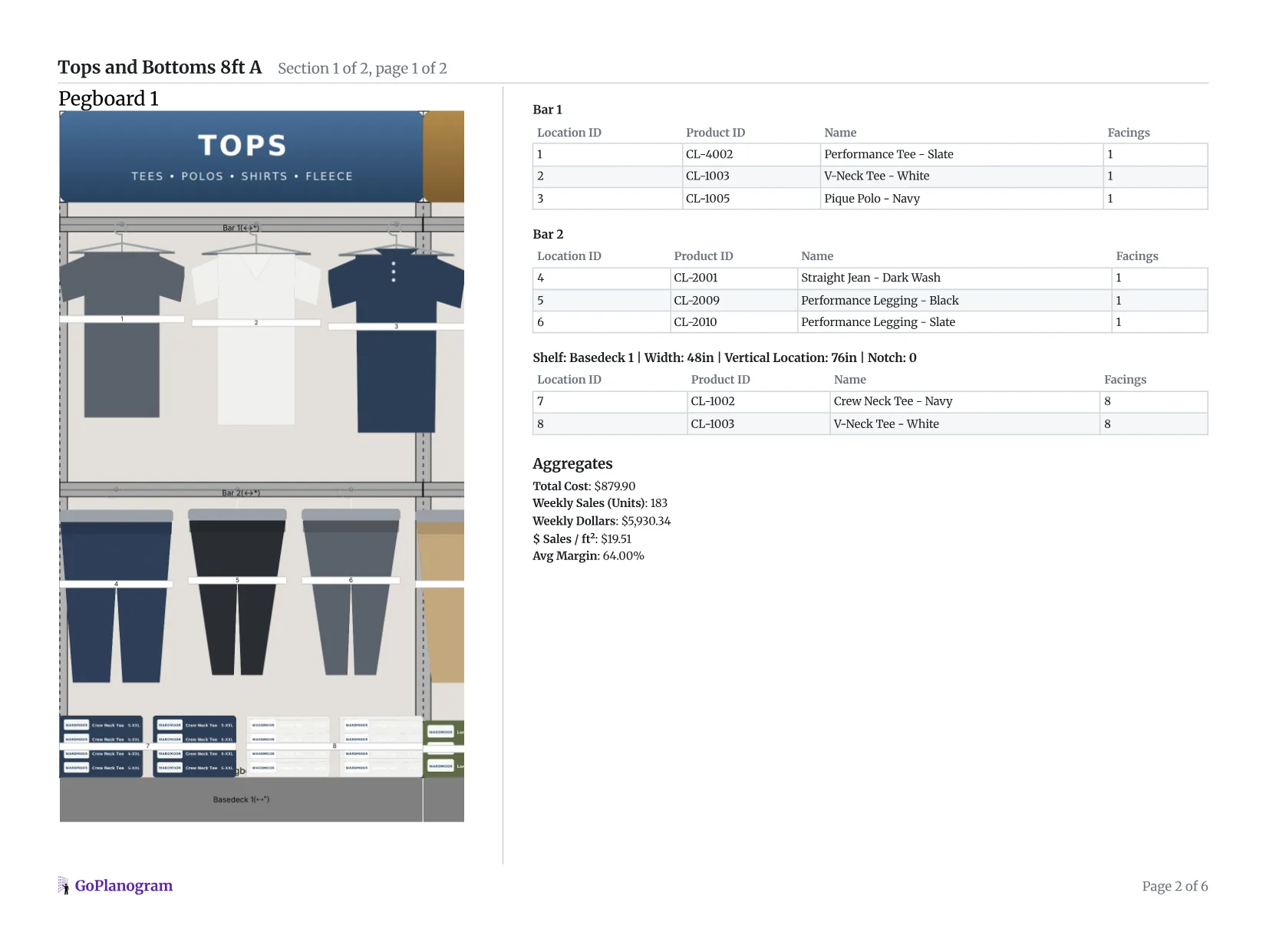
This is the side-by-side report GoPlanogram makes from a planogram: the section on one side, the list of what goes where on the other, with a bill of materials for the fixtures at the end.
- 1
Front and 3/4 views
The report opens with the set drawn flat and in 3D, so the buyer sees how it will look in the store before anything is reset.
- 2
Location IDs
Styles are numbered to match the list, so every store hangs the same tops over the same bottoms, on the same bar.
- 3
Facings per style
Facings by style tell the buyer which pieces face out and how much of the wall each one takes.
- 4
The numbers for every section
Each section's weekly sales, sales per square foot and margin, then a chart of each category's share of the wall against its share of sales, to back the styles you put at eye level.
For the line review itself, GoPlanogram also compares planograms, so the buyer sees what changed from last year's set.
What buyers expect
Size and color depth
Which styles face out, which hang or fold behind them, and how deep each size run goes.
Outfits on the wall
Tops shown with the bottoms they pair with, so the wall sells complete looks and more than one piece.
Seasonal changeovers
A plan for what moves in and out as the season turns, without rebuilding the whole wall.
A style list and schematic
A schematic and style list to review; retailers that plan walls in JDA / Blue Yonder may also ask for a PSA file.
How should a clothing wall be merchandised?
Apparel sells on how it looks together, and a wall has to be easy to shop and easy to put back after a busy weekend.
Let color flow
Arrange color in a deliberate order, light to dark or warm to cool, left to right. A wall in one color order is easier to take in from across the store.
Tops over the bottoms they go with
Hanging tops directly above the bottoms that pair with them shows a shopper the whole outfit and makes it easy to buy both.
Keep size runs consistent
Run sizes small to large in the same direction on every bar, front to back or left to right, so a shopper who finds their size once can find it everywhere.
Faceout the hero, sidehang the depth
A faceout shows the front of a key style. Sidehung and folded stock hold the size and color depth behind it. Use faceouts for the styles you want noticed.
Key styles at eye level
New arrivals and higher-margin pieces go on the eye-level bars. Basics that shoppers seek out on purpose, like core tees and jeans, can sit higher or lower.
Group by category and use
Keep tees, polos, shirts and sweatshirts in clear groups, and keep activewear together, so shoppers browse by what they came for.
When should apparel face out, sidehang or fold?
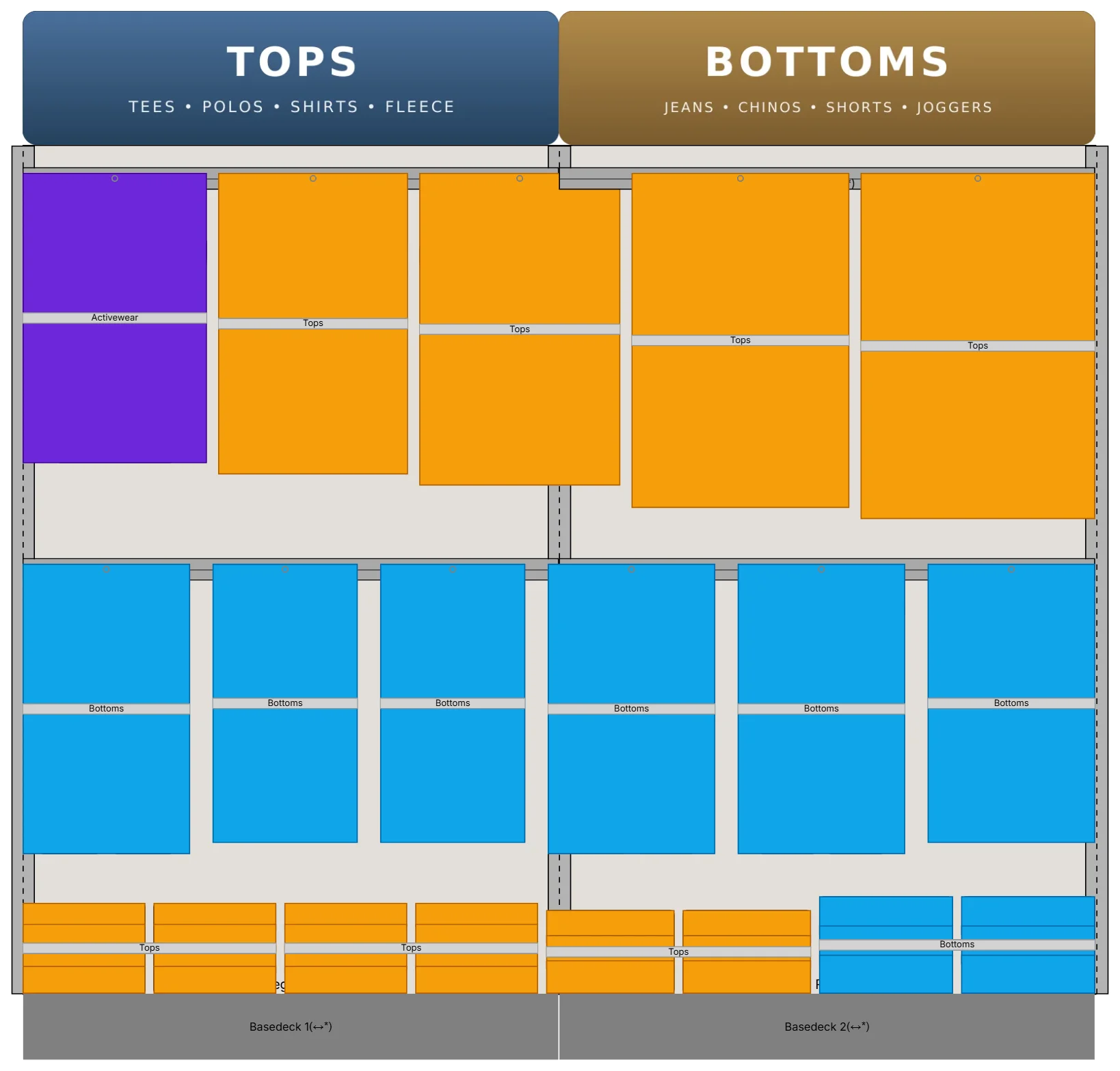
What each presentation does and where it usually goes. Most walls use several.
| Presentation | What it shows | Use it for | Where |
|---|---|---|---|
| Faceout | The front of one style | Key styles and new arrivals | Eye level |
| Sidehang | Size and color depth | Shirts, hoodies and pants | Straight bars beside the faceouts |
| Folded | Size depth for basics | Core tees and jeans | Shelves and base decks |
| Pegged | Packaged items | Socks, underwear and accessories | Pegboard, common on mass walls |
How to make a clothing store planogram in 5 steps
- 1
Start from the wall you are given
The retailer sets the wall or fixture and its bars, faceouts and shelves. Work out how many hangers each bar holds before placing a style.
In GoPlanogram: Hanging bars can be set to the retailer's hook count and spacing, and each style snaps to a hook. How it works
- 2
Pair tops with bottoms
Put each top above the bottoms it goes with, so every section of the wall reads as an outfit.
- 3
Let color and size flow
Run color light to dark or warm to cool across the wall, and sizes small to large in the same direction on every bar.
- 4
Choose faceouts and depth
Face out the key styles at eye level, sidehang or fold the size and color depth behind them, and keep basics lower.
- 5
Plan the changeover and deliver
Mark what swaps out next season, and send the schematic and style list, with a PSA file if the retailer asks for one.
In GoPlanogram: Compare this season's wall with next season's to show which styles change. How it works
You can try steps 2 to 4 on the example below. Add shelves builds the fixture, and the demo catalog has the products.
How do apparel planograms differ by retailer?
Mass merchants roll the same wall out to every store, while off-price stores work from loose guidelines.
Department and specialty
Kohl's, Macy's, JCPenney, Old Navy, Dick's Sporting Goods
Brand and lifestyle presentation on walls and floor fixtures, with visual merchandising direction sent to every store for each season.
Mass merchants
Walmart, Target, Costco
Standardized wall planograms rolled out to many stores, often on pegboard and faceouts, with deep size runs of basics alongside seasonal styles.
Off-price
TJ Maxx, Marshalls, Ross, Burlington
A constantly changing assortment, usually organized by category and size more than brand, with looser guidelines than a fixed planogram.
Retailer names are trademarks of their respective owners and are used only to describe the stores these planograms suit. GoPlanogram is not affiliated with or endorsed by them, and these examples are not any retailer's official planograms.
Try it in GoPlanogram
Open the example in a limited demo of GoPlanogram: move products, change facings, add shelves and download an image. Your own catalog, saving, PSA files, reports and analytics are in the full version.
A limited demo of GoPlanogram, with fictional demo products. No signup needed. Works best on a computer or tablet.
What's in the clothing planogram example
The example is an 8-foot apparel wall, two 4-foot sections with hanging bars. The upper bars carry men's tops: a V-neck tee, a performance tee, a pique polo, a flannel shirt and a pullover hoodie. The lower bars carry the bottoms that go with them: straight jeans, chinos, a fleece jogger and performance leggings.
Folded crew neck, V-neck and long sleeve tees and slim jeans fill the base decks, for 14 fictional demo styles. Tops hang over bottoms and the folded depth sits under both, as on most apparel walls. Try swapping which tops go over which bottoms, or add a third section.
Apparel categories in the demo catalog
- check Tees: crew neck, V-neck and long sleeve
- check Polos and woven shirts
- check Sweatshirts and hoodies
- check Jeans and chinos
- check Joggers and leggings
- check Activewear
What this demo leaves out
The demo is GoPlanogram with most of it switched off. The full version is what suppliers and retailers plan with every week, with their own catalog, data and team.
It starts at $5,500 a year for five users, with unlimited planograms and support included. See pricing
| Feature | This demo | Full GoPlanogram |
|---|---|---|
| Drag-and-drop products onto shelves and pegboard | check Included | check Included |
| Example planograms with demo products | check Included | check Included |
| Download as an image | check Included | check Included |
| Import and export JDA / Blue Yonder PSA files | Not included | check Included |
| Your own product catalog, images and dimensions | Not included | check Included |
| Save, version and share planograms with your team | Not included | check Included |
| Every fixture type, fully configurable | Not included | check Included |
| Sales and margin heatmaps, space-to-sales reports | Not included | check Included |
| Pitch-ready PDF reports for buyers, plus spreadsheets and CSV | Not included | check Included |
| Compare a proposal with last year's planogram | Not included | check Included |
| Reusable components, templates and assortments | Not included | check Included |
Clothing planogram FAQs
- What is a clothing store planogram?
- It is the plan for an apparel wall or fixture, showing which bar, shelf or hook each style goes on. Apparel planograms are usually organized by category, color and size, with key styles faced out at eye level.
- Do apparel brands send planograms to retailers?
- Many do, especially into mass and department stores: a wall or fixture plan that shows how the line should be presented, plus a style list. Off-price retailers usually work from looser guidelines instead.
- Can I make a Target or Kohl's planogram?
- Yes, as a proposal for how your line is presented. Target rolls standardized walls out to many stores, while Kohl's leans on brand presentation each season. GoPlanogram handles the bars, faceouts and shelves, and exports a PDF or PSA file.
- What is the difference between a planogram and visual merchandising?
- Visual merchandising is the overall look of a store: windows, mannequins, displays and how a space feels. A planogram is the exact plan for one fixture, which product goes where and how many. Apparel brands and retailers use both.
- Should apparel hang or be folded?
- Hang the styles that sell on how they drape and look, like shirts, hoodies and pants, and fold the basics that shoppers buy by size, like core tees and jeans. Many walls do both: a hanging style above, its folded depth below.
See your apparel line on each retailer's wall
Apparel brands use GoPlanogram to plan walls and fixtures for each retailer and season from their own styles and sales, and send them as PDFs, spreadsheets or PSA files.
Request a demo
A live walkthrough with the team that makes GoPlanogram.
See everything in the full version
Read the full feature list and our published pricing, no form required.

